
Search New York Criminal History
New York criminal history records hold key data about arrests, charges, and case outcomes across the state. The Division of Criminal Justice Services keeps the main database of fingerprint-based records for all 62 counties. You can also search court records through the state court system or look up people held in state prisons. Each county has its own clerk and sheriff that handle local criminal history records too. This page covers the best ways to search for criminal history in New York, the state agencies that hold these records, and how to get copies or check case status on your own.
New York Criminal History Overview
How to Search New York Criminal History
New York has two main paths for a criminal history search. The first goes through the Division of Criminal Justice Services, which is the state's official repository. DCJS holds fingerprint-based arrest records and case results. The second path runs through the Office of Court Administration, which offers a statewide Criminal History Record Search based on name and date of birth. Each method gives you a different type of result, so the one you pick depends on what you need.
The DCJS record review is the more thorough option. It requires fingerprints to match records, so the results are tied to a specific person. You get either a copy of your New York State rap sheet or a "no record" response. DCJS offers two types of criminal history records. Unsuppressed records show your full history, including sealed items. Suppressed records leave out sealed charges, dismissed cases, and youthful offender adjudications. The cost is $14.25 for New York residents and $44.25 for those who live out of state.
The OCA Criminal History Record Search takes a different approach. It matches an exact name and date of birth against court records from all 62 counties. The fee is $95 per search. Results cover open, pending, and conviction data from County, Supreme, City, Town, and Village courts. Sealed records do not show up. Cases with only non-fingerprintable charges like violations or infractions are also left out. Under New York law, the CHRS report will not show cases that have no final disposition and no court activity for the past five years, unless there is an open arrest warrant.
The DCJS criminal history search portal is the main hub for fingerprint-based record requests in New York.
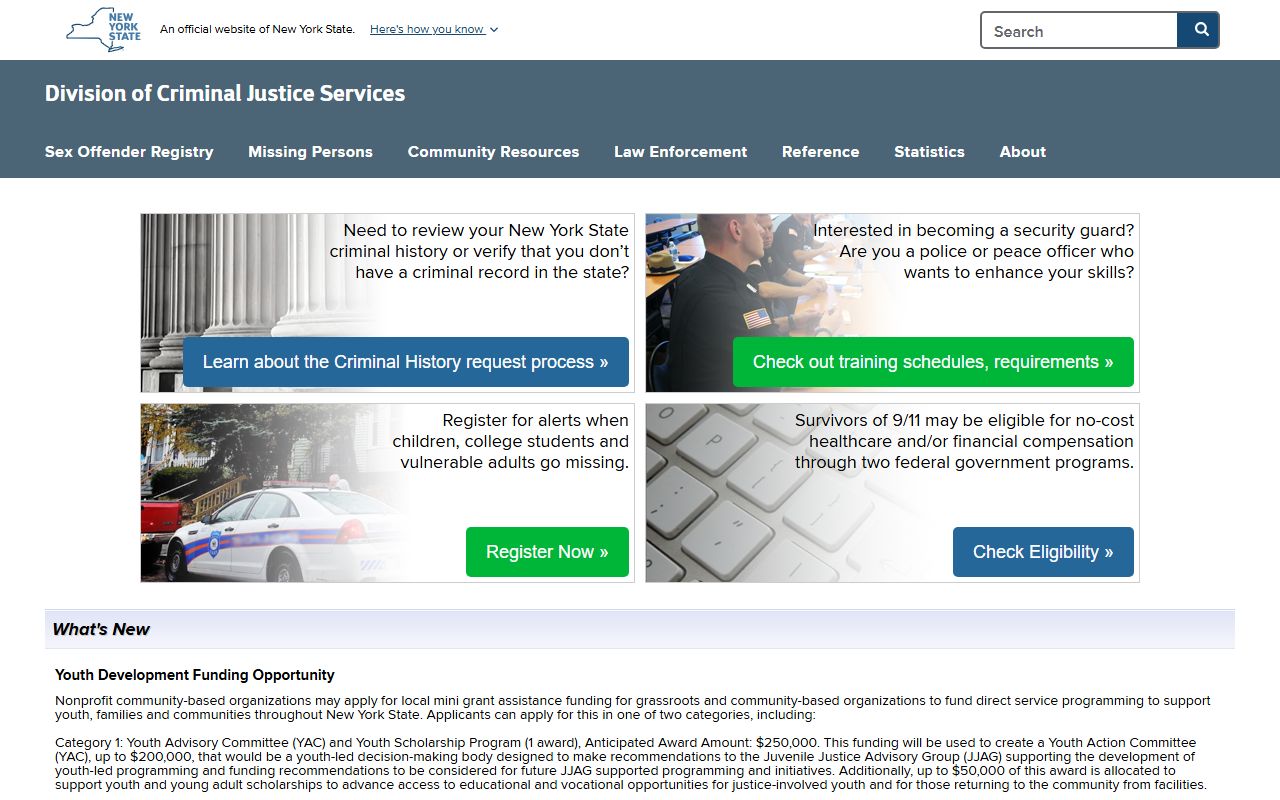
This agency collects crime data, runs the DNA Databank with State Police, and oversees probation programs statewide.
The OCA provides its Criminal History Record Search through a Direct Access online program that runs around the clock for public use.
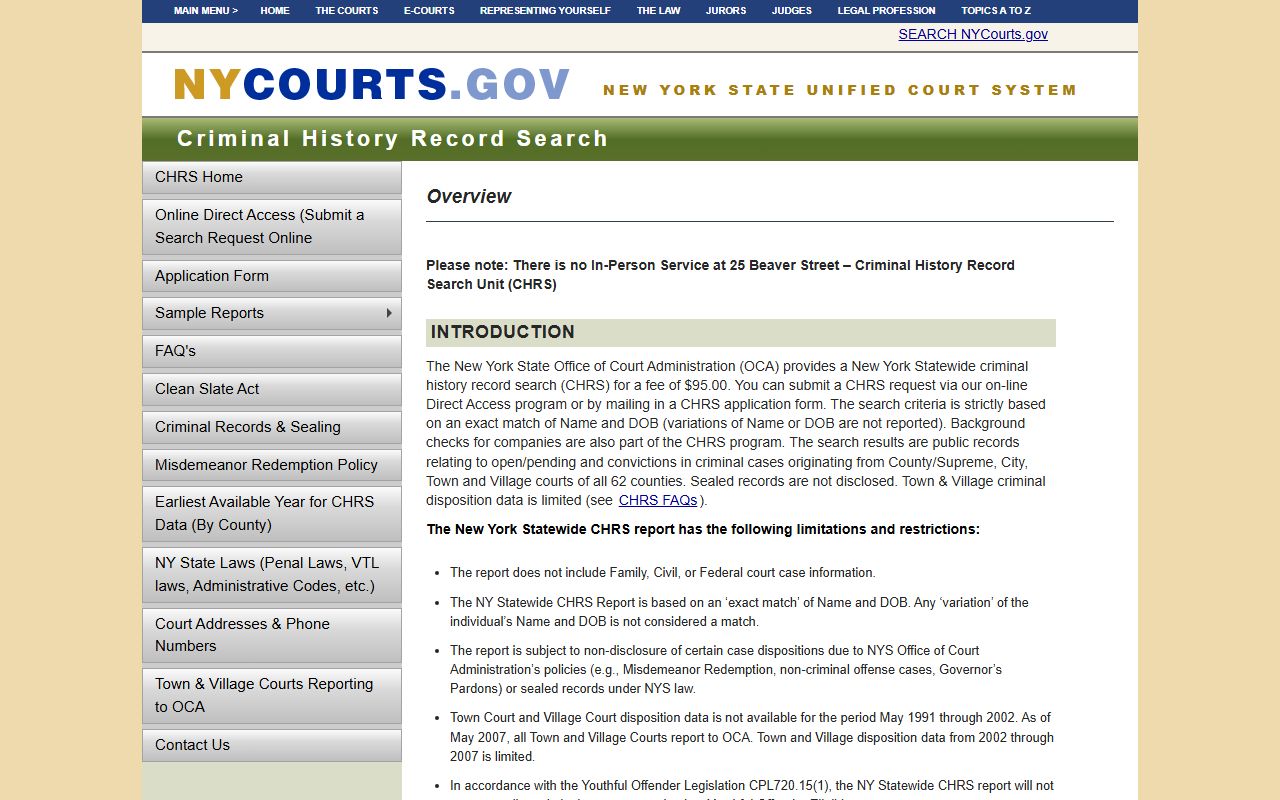
Public accounts let you run up to five name searches per request with a debit or credit card. Results that find no match come back in real time.
DCJS Record Review Process
Getting your criminal history through DCJS starts with fingerprints. You must submit a set of prints so the agency can match them to records on file. This is done through IdentoGo, which runs fingerprint collection sites across New York. The full personal record review through IdentoGo costs about $60.75. Once DCJS gets your prints, they check them against the Statewide Automated Fingerprint Identification System, known as SAFIS. This system holds over 7,000,000 criminal and civil fingerprint records. It has been running since 1989 and was the first state system in the country to search the FBI's nationwide database of 600 million prints.
DCJS is not a public records source in the usual sense. Criminal history records held by DCJS cannot be obtained through the Freedom of Information Law. The agency does not hand out records to third parties or to companies that sell background checks. You can only get your own record through the formal review process. If you believe your record has errors, you can challenge it. For arrest data, contact the police agency that made the arrest and ask them to send corrections to DCJS. For disposition data, get a certified copy from the court and send it to DCJS at 80 South Swan Street in Albany. More details on this process are in the DCJS Criminal History FAQ.
New York's SAFIS system processes about 500 new fingerprint cards each day and has made over 21,000 latent identifications since it started.
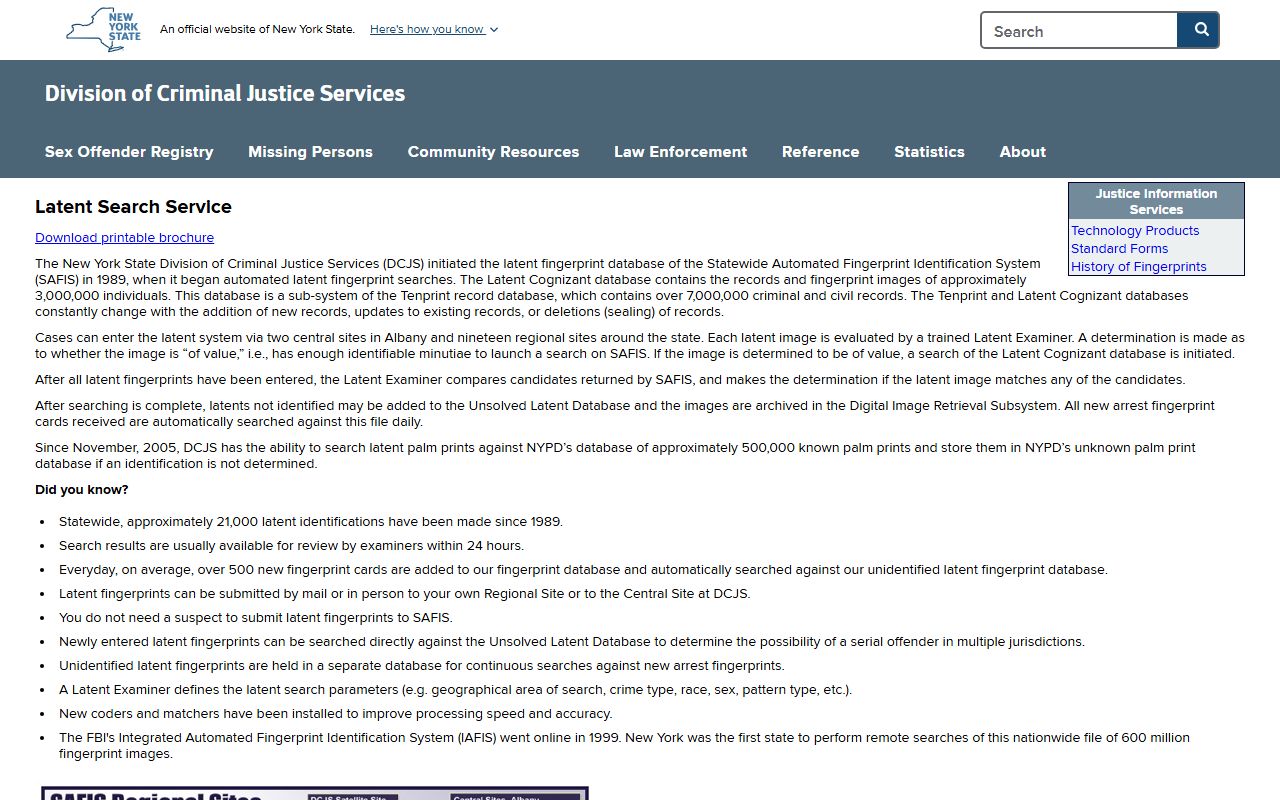
Latent fingerprint searches go through two main sites in Albany and nineteen regional sites around the state. Results come back within 24 hours for trained examiners to review.
Note: DCJS criminal history records are not public records and cannot be requested through FOIL. Only the individual can request their own record through fingerprint-based review.
Criminal History Court Records in New York
The New York State Unified Court System runs several online tools for criminal case searches. eCourts is the main portal. It ties together case search tools for criminal, civil, family, and housing courts. WebCriminal, also called WebCrims, lets you look up pending criminal cases that have future court dates. You can search by case number, defendant name, or court calendar. There is a mobile version too. This service is free.
The Court of Appeals Public Search covers the state's highest court. You can search civil and criminal cases by party name, decision date, argument date, or authoring judge. This is where appeals from the Appellate Divisions end up. The court sits at 20 Eagle Street in Albany.
The Court of Appeals public search page lets you look up both civil and criminal decisions from New York's top court.
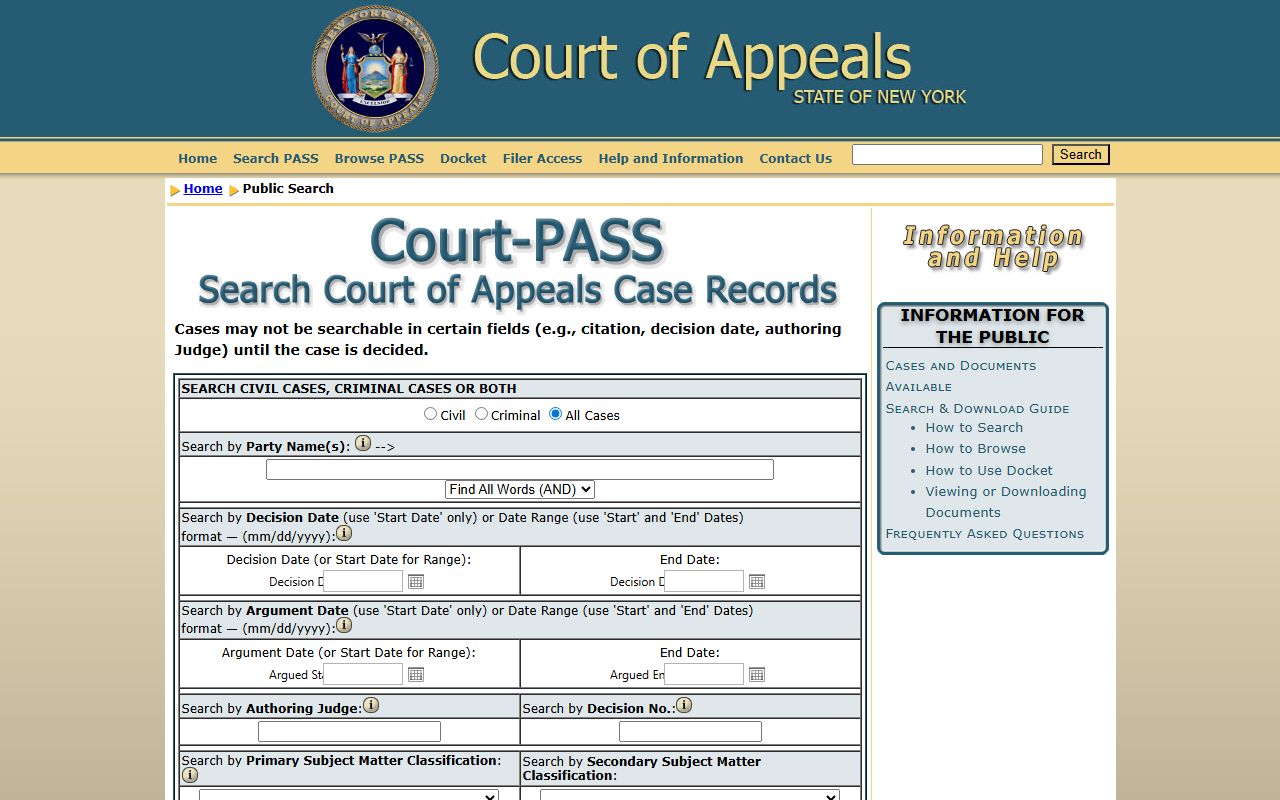
You can filter by case type to see just criminal matters and narrow your results by date range.
For people in New York City, NYC311 provides details on how to order a Criminal History Record Search. You can get the application and instructions through 311. The court needs a full name with middle initial and full date of birth to run the search. Partial names are not accepted. The fee is $95 and you can send results by email or mail.
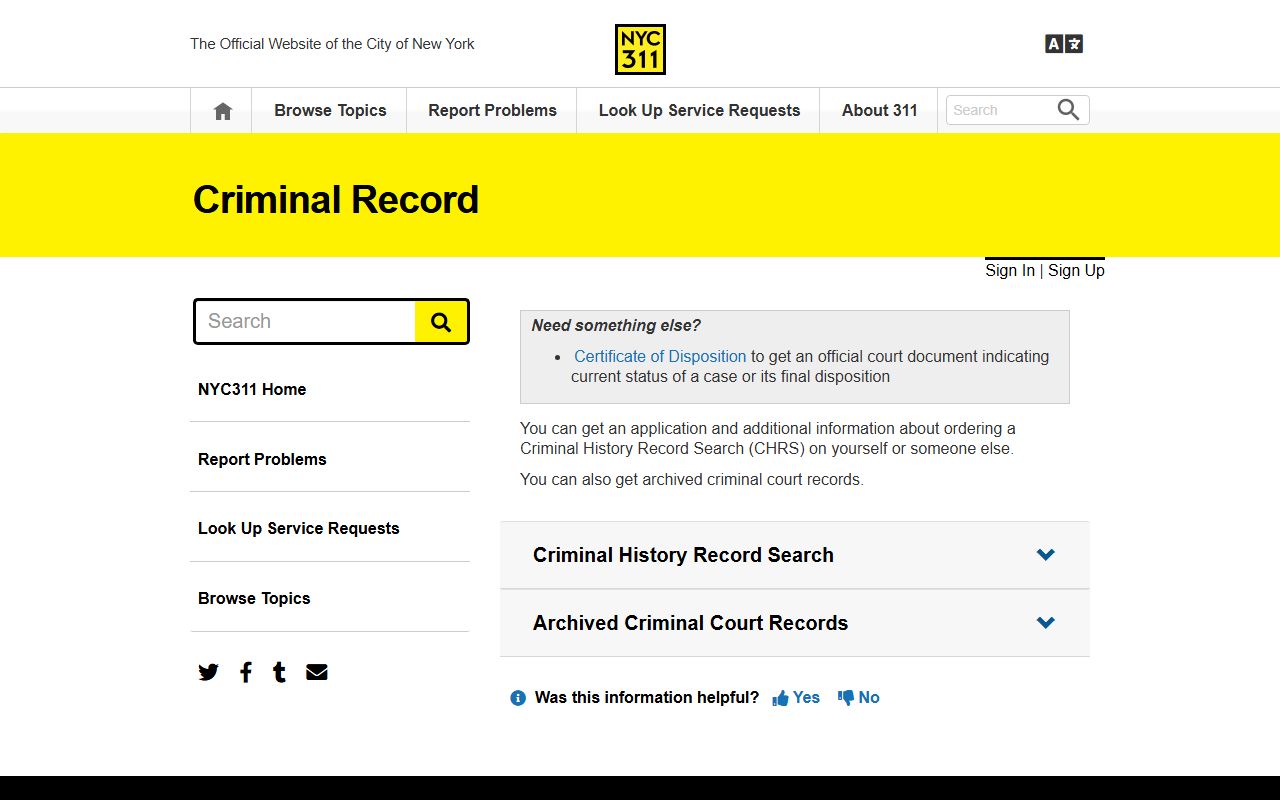
Requests go to the OCA Criminal History Record Search Unit at 25 Beaver Street in Manhattan. They process most requests the next business day.
Corrections and Inmate Databases
The Department of Corrections and Community Supervision runs New York's state prison system. DOCCS keeps records on people sentenced to more than one year of incarceration. The agency also tracks people on state parole. Under Correction Law Section 618, local jails must fingerprint inmates and send the data to DCJS so records stay linked to the right person.
DOCCS provides a free online tool for searching incarcerated people and recent releases.
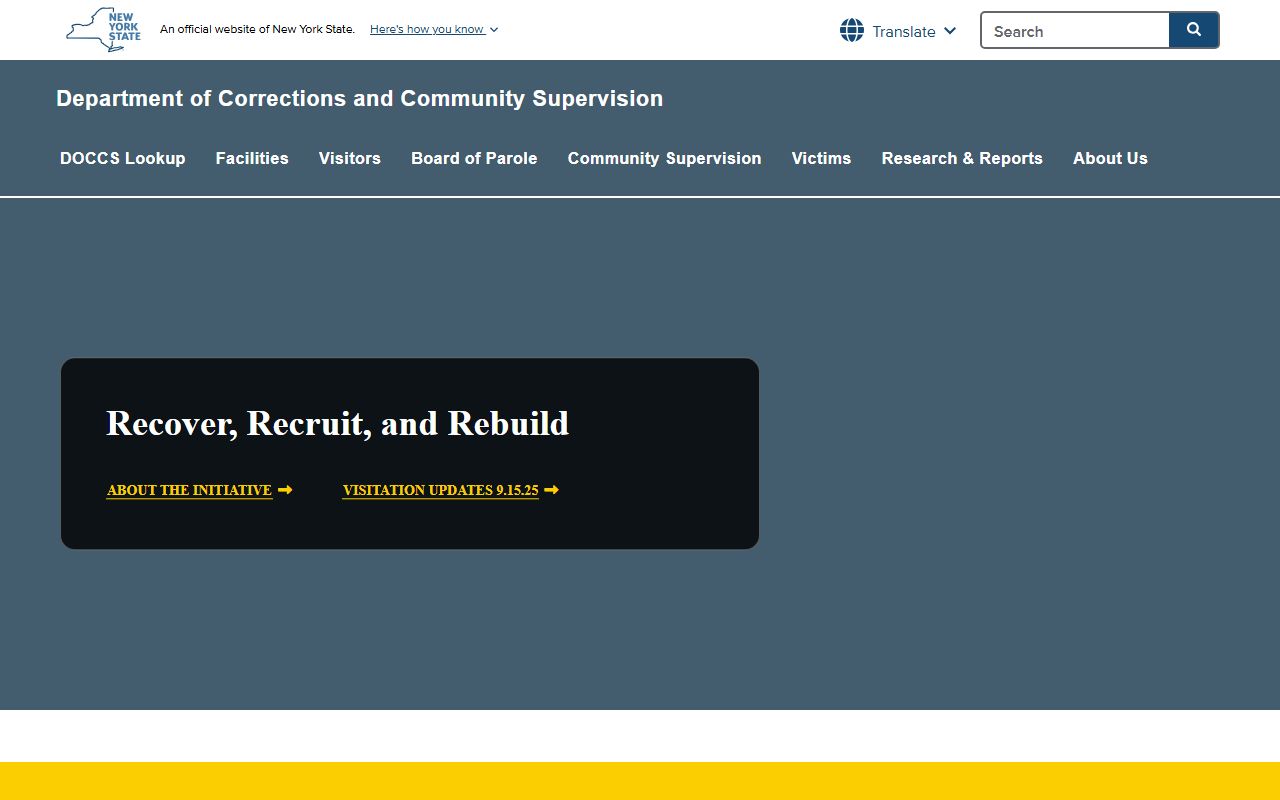
The system covers state facilities and provides conviction charges, sentence details, and custody status for each person in the results.
The DOCCS Incarcerated Lookup tool lets you search by name or Department Identification Number. Records go back to 1982. You can find conviction charges, sentence info, and whether someone is still in custody or has been released.
The parolee lookup is a separate search that shows people under active parole supervision and their conditions.
New York also keeps a Sex Offender Registry run by DCJS under the Sex Offender Registration Act. SORA took effect on January 21, 1996. Offenders get one of three risk levels. Level 1 is low risk, Level 2 is moderate, and Level 3 is high. The public can search the online directory for Level 2 and Level 3 offenders. For Level 1 or unclassified, call 800-262-3257 with the person's name and one identifier like a date of birth or address. The Sex Offender Registry main page has full details on what information is made available to the public.
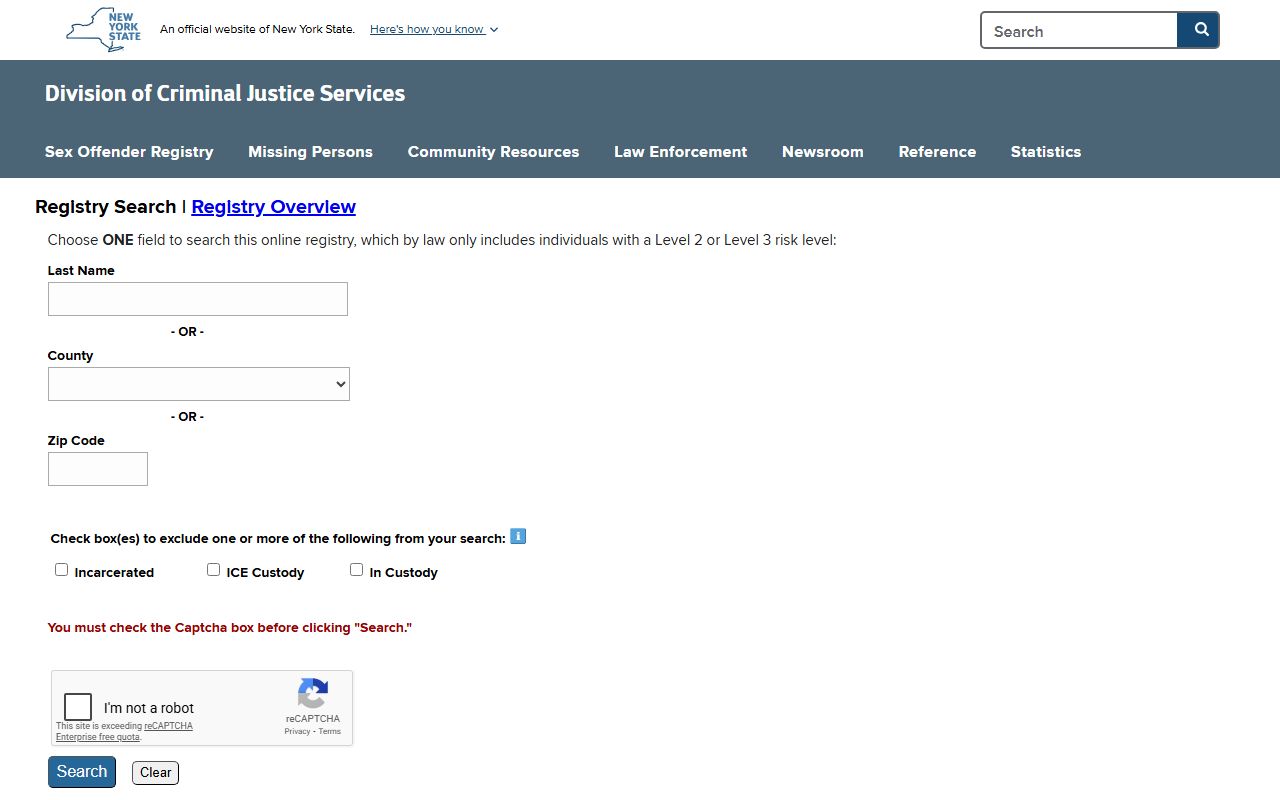
Sex offenders with a sexual predator, sexually violent, or predicate designation must stay on the registry for life. All others register for twenty years.
Criminal Record Sealing in New York
New York has several laws that allow criminal records to be sealed. CPL 160.50 provides complete sealing when a case ends in the defendant's favor. That includes acquittals, outright dismissals, and dismissals after an adjournment in contemplation of dismissal under CPL 170.55 or 170.56. When a case is sealed under this section, fingerprints, photos, and all related records are destroyed.
CPL 160.55 covers partial sealing. This applies when charges get reduced from a felony or misdemeanor down to a violation. The court records remain available as public records, but the arrest information is sealed. CPL 720.35 deals with youthful offenders. A youth is someone charged with a crime that happened when they were at least 16 but under 19. If the court grants youthful offender status at sentencing, all official records on file with the court, police, or DCJS are sealed automatically.
The Office of Probation and Correctional Alternatives oversees probation services and works with the sex offender registry process throughout the state.
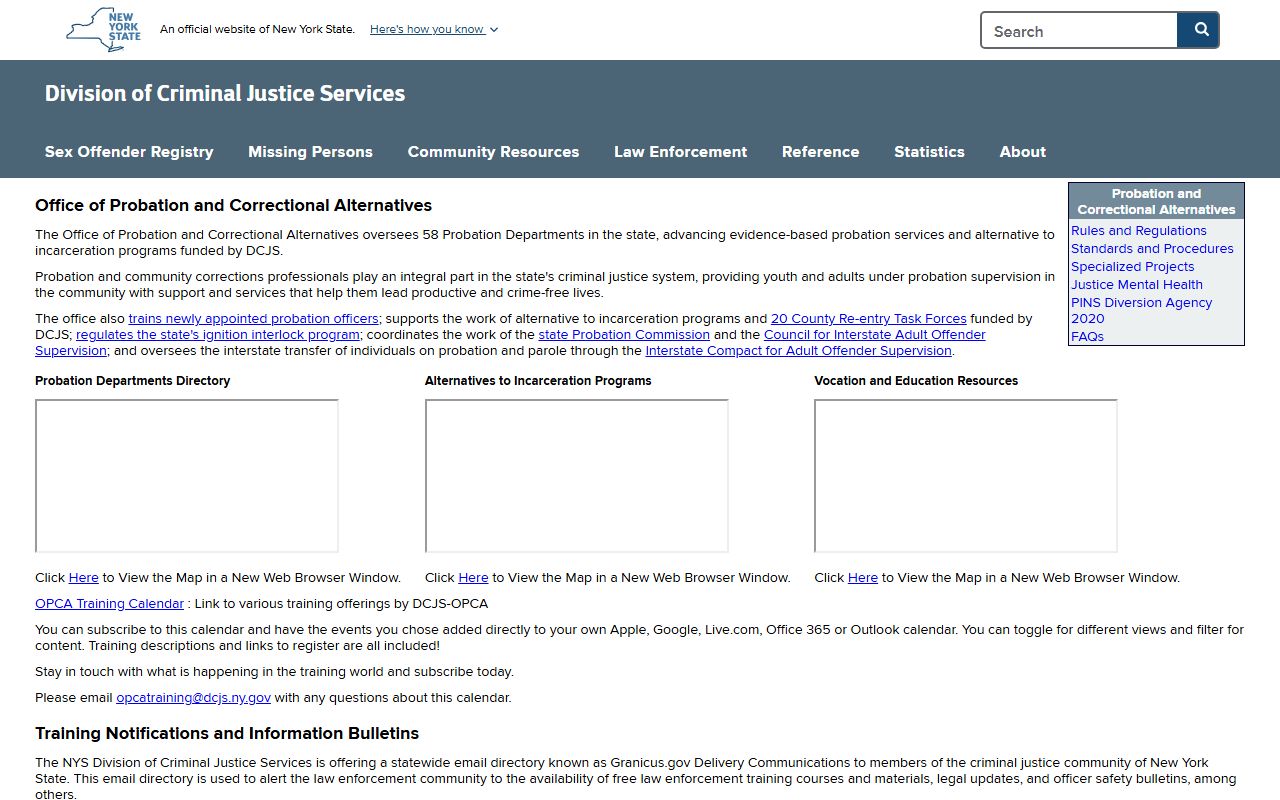
OPCA is part of DCJS and provides guidance to local probation departments across all 62 counties.
The Clean Slate Act took effect on November 16, 2024. It gives the Office of Court Administration up to three years to build out processes that will automatically seal eligible conviction records. Once those systems are in place, certain convictions will be sealed for specific background check purposes. Convictions for sex crimes and non-drug Class A felonies, including murder, will not be sealed under this law. Until OCA finishes the rollout, criminal history records from DCJS will still show convictions that will eventually qualify for sealing.
New York Criminal History and FOIL
The Freedom of Information Law, found in Public Officers Law Article 6, Sections 84 through 90, gives the public a right to access government records. But there is a big catch when it comes to criminal history. You cannot use FOIL to get criminal history records from DCJS. Those records are only released through the fingerprint-based review process. FOIL does work for other types of records held by police, sheriffs, and county agencies. You can request arrest reports, incident reports, and other documents from local law enforcement through FOIL.
The DCJS FOIL page explains what you can and cannot request from the agency.
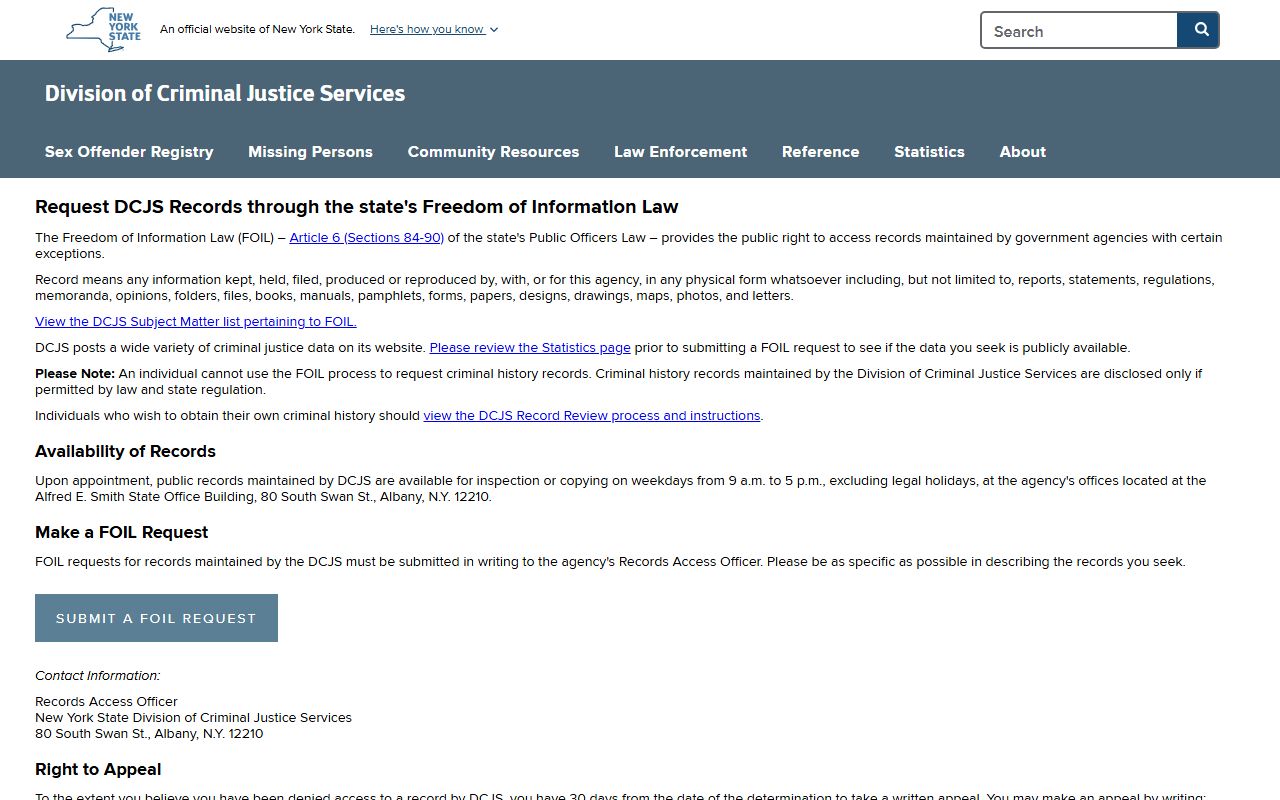
FOIL requests to DCJS must go in writing to the Records Access Officer at 80 South Swan Street in Albany. You have 30 days to appeal if your request is denied.
The Committee on Open Government helps both the public and government agencies understand FOIL rules. They publish advisory opinions and offer training. If you think an agency wrongly denied your records request, the Committee can provide guidance on your options.
The Committee keeps a searchable database of past opinions on FOIL matters. Their staff attorneys answer questions from the public about open records laws.
At the county level, many offices now have online FOIL portals. You can submit requests and track them through these systems. Each agency must acknowledge receipt within 5 business days under Public Officers Law Section 89(3). Standard copies cost $0.25 per page. Response times vary, but agencies generally have 20 business days to provide records or explain any delay.
Browse New York Criminal History by County
Each of New York's 62 counties has its own County Clerk and Sheriff's Office that handle criminal history records at the local level. Pick a county below to find contact info, office locations, and local resources for criminal records in that area.
Criminal History in Major New York Cities
Residents of major cities deal with criminal history records through their county court system and local police. Pick a city below to find out which offices handle records in that area.